Tuesday, 27 September 2016

Porto, Portugal

Porto is the capital of the north in Portugal and is the country's second largest city.  Houses with red tiled roofs tumble down the hillside to the riverbank punctuated by beautiful old church towers.  Cobblestone streets are the norm some with mosaic patterned stones.  The old town is today preserved as a World Heritage Site.  We spent a good deal of time meandering up and down the twisty narrow steep streets of the old district enjoying the sights and a glass or two of wine.  We crossed over the river to visit the port wine cellar area of Gaia and of course indulged ourselves there as well.  A couple of hours on the open air tour bus gave us a really good feel for the city and when one is in Porto it seems a boat trip down the Douro is a must and it certainly was a great way to get a different view of this unique city.  The streets were very busy with even small cafes having a couple of tables outside.  It would seem that you were on a pedestrian street as it was so narrow and covered with people and then a taxi would wind its way through.  Would be a drivers nightmare.
Porto is situated on the Douro River which snakes picturesquely through the city.  Tour boats travel continuously up and down the river treating the multitude of tourists to views of the city from the river.
Porto is very hilly and rises steeply from the banks of the river 
The cathedral sits high up on the hillside
Built in the 1700s the church is built of white granite typical example of northern Potugal
The baroque altars are very lavish and were designed by Italian craftsman 
Streets are jammed with pedestrians even though this is not a pedestrian street. The tour bus we were on went down this street and the people simply parted like a giant wave.
The side of this church was decorated with a beautiful design all done in tiles
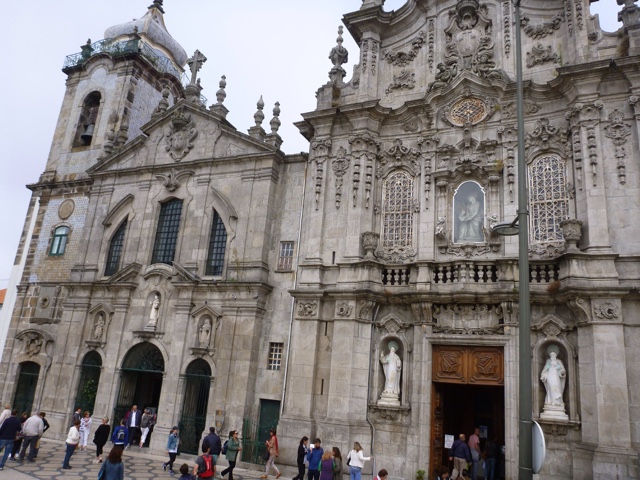
This is actually two churches and as it is dictated that two churches of different denominations cannot be joined the narrowest house in Portugal joins them.  The house is the door and two windows between the churches and is one meter wide.  It would be quite fascinating to see inside.
These fishing boats sit peacefully waiting for their owners evidence that some still rely on old ways to make a living.
Following the winding narrow cobblestone streets in search of a port house.
Inside Taylor Fladgates barrel cellar.  Years of port just waiting to be drank.
Eric in his happy place in the tasting room at Taylor Fladgate.
The streets are so narrow that you can hardly see them through the density of the buildings.
Not an inch to spare between buildings
Old port transport boats called rabelos sit moored along the river.

Sidewalk cafes are everywhere and yes I am standing in the middle of a street though no one seems to pay any attention 
The busy Ribeira as the waterfront is called is teaming with people and is a great place to sit and have a glass of wine and observe.
Church towers pop up between colorful buildings all through the old town.

The church on the right is Sao Francisco and is Portos only Gothic church. Though the outside is plain the inside is stunning with lavish carvings all covered in gold leaf from the early 1700s.  After visiting the church one descends down into the  crypts where the walls and floors are lined with tombs and the remains of the parishioners end up in a bone heap or ossuary which is viewed through a trapdoor if the skulls on top of the tombs were not quite creepy enough.
Six bridges cross the Douro River in Porto with this combination being the busiest. Called the Ponte Dom Luis I the upper bridge is for the metrotrain system and the lower one for vehicles. Both have pedestrian walkways. The views from the upper bridge were spectacular
The whole city is inhabited and it was very common to have someone hanging their laundry out over the umbrellas of a restaurant down below.  Really added to the lively nature of the city.
Tiled buildings of every colour add vibrancy to the city


Saturday, 24 September 2016

From Sea to Shining Sea

It was with many mixed feelings that we dipped our boots into the North Sea on September 21st finishing our hike across England. We have walked over two hundred miles and done almost 34,000 feet of elevation gain.  For every foot we went up we also went down as we started and ended at sea level so it has been a real roller coaster.  The scenery has been ever changing from the hills and valleys of the Lake District, the sheep populated rolling green pastures with their beautiful stone walls of the Yorkshire dales,miles of moors where the bronze heather contrasts vividly with the bright greens in the distance,forests with small rivers running along our way and often walking through small villages as people went about their daily lives.  We stayed in small mostly old English hotels which had few rooms and often a very homey feeling which was really nice. A cold beer or cider at the end of each long day tasted so very good.  This was definitely a hike and a hard one at that but after the first couple of days I am able to truthfully say I am very thankful that I did this. It was a great experience and one that for me was a big challenge.  It pushed me at times beyond what I thought I could do and I know I have finished in better shape than when I started.  Thank God for my own personal cheering team comprised of Eric!  Now we are off to Portugal to celebrate with some fine wine and port!
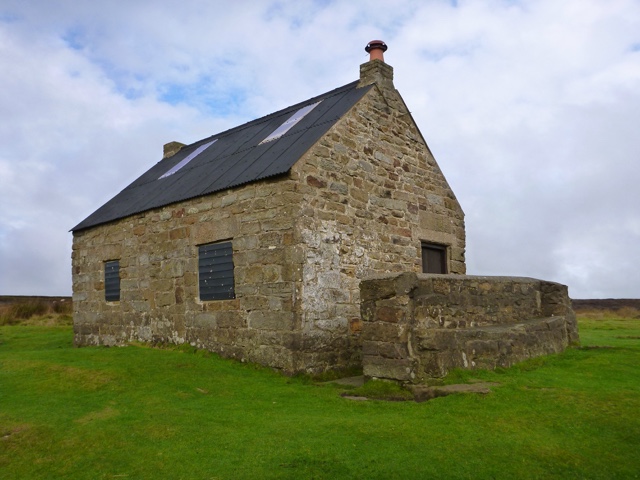
Crossing the moors the miles of heather glowed a bronze colour.  As we neared the east coast we did see some pink as the cooler weather made for a later bloom.  The moors are home to literally thousands of grouse.
Large parts of the moors are private estates and individuals pay very large sums of money to go grouse hunting.  Local lads are hired to sweep the birds out of the moors while the hunters dressed in shirts and ties and hunting pants stand behind the wall at one of these shooting houses and shoot.  They even have someone there to quickly reload for them and of course to pick up the birds.  Not much of a sport but apparently very big business in Britian.
Pathways through the moors were variable and one could often see for miles, down into the far valley.  Our last few days on the trail we did meet with some strong winds and heavy mist but the rain only appeared at night which was just enough to make some of the trails very muddy but at least we were dry.  After a couple of days of hiking we gave up washing our pants each night and just went with the mud.  We all felt a bit odd going to breakfast looking like we had not washed our clothes in weeks but so be it.

This grouse sitting amongst the heather has no idea what fate awaits him.
Walking out of the moors we once again hiked through farmers fields.  Harvesting was in full swing yet the farms seemed to have an old time feel about them.
Farmers gates, pastures, rock walls and a church steeple offered a peaceful feeling of all is good as we headed ever closer to the coast.
We often walked right through people's yards.  The old brick homes and English gardens were delightful
Nearing the coast the trail passed through some lush but often very muddy forest.
To my delight we found more rivers to cross.  Glad I did not know about these in advance.
Walked along an old toll road where this sign was still on the side of the house.  One would have thought they could have let the newly departed pass for free!
This is the train station at Crossman and is the station where they filmed Harry Potter arriving at Hogsmeade. We took the train that they used in the film to this station as a little side trip

Our last day on the trail started with a steep hill right away and this was our guide Pete injecting some humor into the day.
Up and over and getting very close
The homes seemed to be out of another era and seeing the new fancy cars parked in the driveway looked out of place
We saw these flood markers in a few places which is a testament to how much rain can fall here. I do not think that irrigation specialists would have great careers in this part of the world.

Walking through the woods on our last day took us through mud, stone, roots and along peaceful pathways and surprised us with this lovely waterfall.  The water however looks very brackish and had done during most of our hike due to the peat content in the soil.
Thankfully I did not have to cross this river as the stones would have been very slick
Eric making his appearance out of the woods as we got ever closer to the sea.
Our first glimpse of the ocean as we neared Robin Hoods Bay.  The end was so close but there were still some hills to climb
We hiked along the edge of the cliffs as we drew nearer to our destination
That is me in the distance trekking up one last hill before the long descent to the ocean
And down we went through the most quaint little fishing village. The road was incredibly steep and is two way though some of the larger vehicles hardly fit on thier own. Driving here is not for the weak of heart!
The welcome sands of the bay. Of course the tide had to be out so that we had to walk just that much farther.
Keeping with tradition I threw the stone I carried across from St Bees beach into the North Sea.
Dipping our boots in the ocean with a great feeling of accomplishment that we have made it from coast to coast

The sun Gods smiled on us and we finished with blue skies and dry boots until we stepped into the sea.
This is the route that Wainright laid out and that we followed from St Bees to Robin Hoods Bay. what a journey!
We saw this sign on our way back up the hill after dipping our boots in the sea and celebrating the end of our hike.  We can all take something from his simple message.
The hotel we stayed at overlooking Robin Hoods Bay at the end of our Coast to Coast journey. We thought that it was a rather appropriate hotel for Eric and I.