Thursday, 2 February 2017

Mingle and Magwe


Our first stop of the day was at Minhla which was the site of a great battle during the Second Anglo-Burmese War.  The king had built forts along the river to protect Burma from the English but did not take into account that the English had the ability to travel by land so thus the Burmese were defeated in 17 days.  The fort was interesting to visit but the most fascinating part of the visit to this town was the extensive market.  Most of the items for sale were food and as this is not a big tourist town this is where all the locals shop each day for their needs.  Once again the vendors were happy to show us their wares well aware that we were not going to purchase anything though some of us did buy longyi to wear later.  Some of the smells such as the spices were wonderful and some of the smells did not stir the appetite though they definitely were of interest.
Back on the ship we had a demonstration on how the locals wear the longyi.  This is the traditional outfit of the locals, particularly the men and is very cool and versatile as well as being very cheap.  In Myanmar as soon as we arrived we noticed that most of the women and children had a beige colored paste on their faces and wondered what it was.  We learned that it is Thanakha and is from the bark of a tree.  Not only is it a sun block but it apparently has great medicinal properties for problem skin.  May be a coincidence but he people of Myanmar have wonderful complexions.  The men only wear it in the privacy of their homes as it is not regarded to be manly.
Our next stop was in Magwe where we first visited the Mud Volcano which the locals believe houses fire breathing dragons but we skeptical tourists found to be the first place we would have like to have passed on.  Interestingly it was also the first place we came across beggars.
We visited a park to see a statue of General Aung San Bogyoke where a group of high school students turned us into the attraction before going to the Myathalon Pagoda on the bank of the river.  We were luck enough to arrive there during a novication ceremony where four children were going to become monks and a nun the following day.  This is a very proud time for parents and a great celebration is held including a parade.  The parents were eager for us to take their children's photos.
The fort in Minhla built by Italians which failed to protect he invasion by land.
One sees all sorts of things being pushed down the roads.
The vegetables looked fresh and clean though I could not help but wonder where they had been washed.
Cooking over open fire in the middle of he market 
Wonderful spices
All kinds of dried foods,some not resembling anything familiar 
Stacks of betel leaves to make the betel nuts for chewing.  The more rural we get the more people we see chewing the nuts.  The roads are stained with red from where they spit out the remainder.
Frying up local delicacy.  They smelled really good.
Spices and beans.
Myanmar recycling.  These buckets are made from old tires.
These sandals are also made from old tires and cost the equivalent of one dollar and last up to three years being worn every day.  Pretty good value.
Dried fish and shrimp.  Dried shrimp is used is many of their local dishes and we are getting to really like it.
Local truck on the way to market
A bridge to a house.  In rainy 


Pyay

Pyay sits on the eastern banks of the Ayeyarwady River and was established by the British Irrawaddy Flotilla Company as a transshipment point between upper and lower Burma in the late 19th century.  The city is home to more than 80 guided pagodas.  We went to visit the Payagi Pagoda which not as large as the one in Yangon to us was much more appealing.  The stupa is covered in gold and the whole pagoda glitters.  We were the only tourists visiting and the locals took delight in taking our pictures.  Our guides are filling our heads with information regarding the Buddhist way of life which is quite fascinating. From one area of the pagoda one looks directly over at a ten story high sitting Buddha rising hig out of the tree line.
We then went to visit Bawbawgyi Payi which is a cylindrical shaped stupa built of brick and plaster and is the oldest stupa in the area.  It still has a gold top where loyal followers make their contributions in gold.
Traveling along the river is fascinating.  Right now the river is at its lowest depth and is only six feet deep in many places so navigation is very tricky and impossible for some boats at this time of year.  This ship only draws four feet of water making it possible to go up the river under these conditions though there is is often a crew member on each side of the boat measuring the depth with a stick.  Very high tech!  The river is dotted with huge sandbars which often have small nomadic villages set up on them of fishermen and farmers.  Land that is under water in the rainy season is actively farmed at this time of year.  The sides of the river are often steep sand banks which indicate how deep the river runs during its high point.  In Myanmar the people do most everything by hand and it is fascinating to watch the workings on shore from the boat.  Ox carts carrying loads are a frequent sight and a welcome picture opportunity.  The river itself is busy with boats large and small.  The larger boats and barges are dredging stones from the bottom of the river which are then used in building and are worth a lot of money so this is quite lucrative. A few of the smaller boats are fishing but they mostly seem to be for transportation to get them to their homes and work.

In Myanmar children serve as nuns or monks several times during their lives, sometimes just for a week at a time.  Some serve for a lifetime.
Stupa in Paya. We have seen nothing but clear blue skies.
Within he temple complexes there are dozens of Buddha statues for people to worship before.  Some have different significant meanings, for example some are believed to contribute to wealth and some to fertility.
Around the stupa are eight points representing the days of the week with two for Wednesday.  Buddhists put great significance in the day of the week that they were born and worship at the appropriate shrine pouring water over the Buddha for blessing.
Ten story high Buddha rising out of the trees
The local people drink their water from clay pots.  They keep the water cool plus the sediment settles to the bottom so they only drink from the top two thirds.
Oldest stupa in Paya, made of brick but still topped with gold
Gold umbrella at top of stupa where the believers add gold offerings every five years
This gorgeous flowering tree ,the lumbini ,at the site of the stupa is much reveered as it is believed the Buddha was born under one of these rare trees.  The flowers have the most beautiful scent.
Family transportation complete with sun protection 
The AmaPura tied to the bank
Nomadic lifestyle on the sand bars
Small boats for transportation to jobs and market.
Farming on top of the sandbanks.
Small pagodas dot the river.  Some seem to be in the middle of nowhere.always somewhere to go to worship.
Bathing in the river.  Makes one very thankful for hot showers.
Ox cart taking a crop along the river bank
A family enjoying a rest from the heat in the middle of the day.
Fishing nets set up along the shallows of the river
Farming on the fertile land that is under water during the rainy season
Local women doing their laundry.  Everyone we have met has been clean with beautiful shiny hair.
Clothes drying on the river bank.
Sorting hot peppers on the side of the river
Locals coming to take pictures of us.  This is quite common here as we are the oddity.


Tuesday, 31 January 2017

Yangon to Pyay

Today we went on a seven hour bus journey to Pyay where we would board the AmaPura for our cruise on the  Ayeyarwady River. Though the road was apparently the major thoroughfare it was narrow and bumpy and it would seem that horns here may wear out from over use as our bus driver was constantly on his to make the locals on heir various forms of transport move over to let us by.  Motorcycles are not allowed in the cities but are the main form of transport in the rural areas and carry the whole family.  We passed through dozens of small villages with the residents selling heir wares and food along the roadside mostly to other locals as this area is not high in tourist traffic and the local "restaurants "do not call out to the weaker stomachs of the tourist as the hygiene leaves much to be desired.  Everywhere we passed by or stopped the people were so warm and friendly.  Their faces are always lit with welcoming smiles and though most are very poor none are begging.  Friendly merchants encourage you to take pictures of their unusual foods.  One fellow was selling barbecued sparrows as well as several different types of dried fish which he was generously trying to give Tina and I samples of.  Tina tried a small nibble of a fish and we graciously turned down the rest.
As we travelled the countryside it was very apparent why this is called the golden country.  One does not go far without spotting a golden pagoda, and often several at a time.  We are told that even though the majority of the people are poor they still give a large percentage, sometimes up to sixty percent, to the temple.  Their belief in reincarnation is so strong that this is so important to them.
The land is flat as far as you could see and often covered with large expanses of rice paddies which is a major export for Myanmar as well as a staple in their diet being served at every meal.
As we neared the river we passed through a teak forest.  It is now against the law to cut down teak trees in Myanmar as the forests were earlier decimated and take a very long time to regrow.
Arriving in  Pyay we boarded the ship via a golden sand pathway to start our adventure on the river.
Workers in the rice fields along he way
Assortment of local delicacies including dried fish and barbecued sparrows
Quails eggs also were a very popular item every where that we stopped.
Along the way amongst the poor villages we came to the most beautifully kept war memorial with stones for each soldier, Burmese and British killed in the war
In such a dry area the grass was green and  there was a well maintained plant beside each stone.  It was a wonderful tribute to those who gave their lives so we could live free.
Typical roadside sight
Local restaurant along the way.  They must do a booming business in plastic chairs and tables as they all seem to have them.


Friday, 27 January 2017

Myanmar

After nearly 18 hours of flying Eric, Steve, Tina and I arrived in Yangon tired but excited to start our adventure. Formerly Burma and once under British rule Myanmar has only opened up to tourism since 2010. Yangon is the country's chief port and now has a population of over 7 million people.  It is a city of amazing contrasts.  Old colonial buildings sit side by side with new hotels and a large percentage of the population still conduct a large part of their lives on the sidewalks selling food and wares and meeting with their neighbors.  The import of foreign cars was only allowed after 2010 and the infrastructure was never developed to deal with the number of vehicles that suddenly appeared thus creating total mayhem on the streets. A driving nightmare. 
The four of us started off by visiting the Yangon zoological gardens which were created in 1905 as a zoo and garden for the people of Burma.  The zoo had a wonderful assortment of animals including elephants, tigers, white rhinos, asian bears, and a red panda.  They had a huge assortment of deer which coming from home seemed odd to see in a zoo.  The bird collection, especially the hornbills was quite extensive.  It was quite evident that they do not put the same value on animal welfare as we do as the enclosures left a lot to be desired.  We later visited the Sule Pagoda which is believed to be built 2200 years ago. Almost 90 percent of the people of Myanmar are Buddhists so pagodas are plentiful.  The gold leaf on the spires is stunning in the sunlight and when lit up at night.
Our first day of our AMA tour we started out with a walking tour of downtown Yangon.  It was fascinating to stop along the sidewalks at the small stands set up as our guide explained what they were selling.  It was particularly interesting to watch the gentleman vendor prepare the betel nut and lime for chewing.  This is an addiction in this part of the world and is a leading cause of oral cancer.  We also went see the giant reclining Buddha which is over 66 meters long housed inside a pagoda and visited Royal Lake to view a reproduction of a royal barge.  We finished our morning tour at the large Scott Market which was a massive complex of adjoining buildings with thousands of vendors selling their wares.  We stepped briefly into the food section but the conditions and smells sent us elsewhere for lunch. 
Our last visit of the day was to the Shwedagon Pagoda which was constructed 2500 years ago. Over the centuries many kings and queens have added their weight in gold to the spire and it has risen higher and higher until. It now stand at 326 feet.  It is topped with a 76 carat diamond and the top is embedded with 4351 diamonds with a total weight of 1800 carats as well as several thousand rubies.  The main spire is covered with hundreds of ponds of pure gold.  The value is staggering.  New shrines and Buddhas are built where space allows by families that want to contribute to their belief for eternity. This is said to be the oldest Buddhist shrine in the world and is a wonder of the religious world.  People come here to worship as well as to spend time with family and friends as a social gathering.  Fascinating to get a glimpse into this way of life.
Red panda bear.  Hard to photograph in the enclosure.
White rhino resting in the hot sun.
Asian black bear having a little sit down.  Loved the markings on his chest.
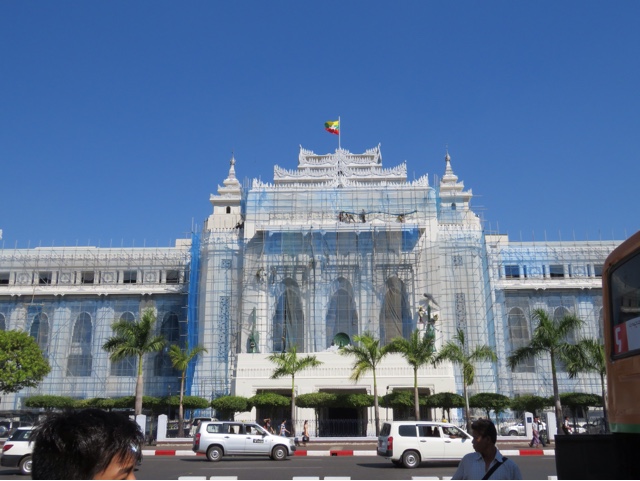
A lot of the architecture in the downtown is English colonial.  The hot sun and the heavy rains in the rainy season where 200 inches of rain in four months is the norm is very hard on these buildings.
This woman was selling bags of dried fruit and candy at her sidewalk stall.
This gentleman was preparing the betel nut for chewing.  This business can be very lucrative and one can make up to 20 dollars a day which is a lot considering that the minimum wage is 3 dollars per day.
This man was making noodles from a block of tofu and then making soup which customers sitting on small stools and eating before continuing on their way.
This building was still occupied though the elements and lack of upkeep gave it and many others an abandoned look.
The giant reclining Buddha though in a pagoda had an almost showy feeling about it.
This craftsman was fascinating to watch.  He was creating an intricate design with handmade noodle like pieces of cement on this chair to put a Buddha statue on.
This is the barge at Royal Lake
The wooden boardwalk goes for over two kilometers around the edge of the lake and is quite scenic.
This woman is sorting and packaging garlic for sale on the street.
The golden Jewell encrusted spire at the Shwedagon Pagoda reaches a height of 326 feet,  unfortunately too far for the eye to be able to see the precious stones.
Dozens of Buddhas and statues and places of worship surround the main spire.
Numerous monks and nuns are throughout the pagoda, many interacting with the visitors.
A worshiper in front of one of the new Buddha shrines being erected by an individual family.
A small child learning how to ring the bell.  A place of worship for all ages.