Thursday, 2 February 2017

Salayto Bagan

Cruising on the river is a fascinating glimpse into the lives of the people who live their whole lives here.  We get to observe from the water as well as make stops at small villages along the way and stroll the dusty streets which to this point have seen very few tourists though this will change in years to come as tourism expands in Myanmar.  
Salay was one small village that we explored by foot.  A group of locals, especially children, always are on hand to greet us when we come ashore wanting nothing more than smiles and high fives.  How refreshing.  This town is famous for its beautiful Yoke Sone Kyaung wooden monastery which is adorned with spectacular woodcarvings.  Though the town has only six thousand inhabitants it is dotted with pagodas and religious monuments.  To enter a Buddhist temple one must go barefoot thus we have never removed our shoes or washed our feet so many times in a day.
Farther up the river we visited Tant Kyi Taung where a pagoda built in 1059 sits high on the hilltop and looks over to Bagan.  Unfortunately the haze obliterated the view somewhat what was still quite something to view the landscape from a different vantage point.
Our next stop was Bagan where we spent a couple of nights to explore this fascinating city.  The capital of the first Burmese empire Bagan has over 2300 religious monuments which are in different shapes and sizes and were built between the 11th and 13th centuries.  Bagan is the richest archeological site in Southeastern Asia.  Arriving in the evening we went to the Guni Temple and climbed to the top to watch the sunset.  Though the sunset itself was not overly spectacular the panorama views were outstanding.  One could see stupas and monuments in every direction.  After the sunset we went to a monastery for a candlelight blessing by one of the monks before returning to the boat.  The next day in Bagan we explored temples, colorful markets, visited a lacquer factory and went to a jaggery palm sugar workshop.  Eric did a different excursion and went to Mt Popa which is an extinct volcano where there are 777 steps to the summit where a pagoda awaits.  It is believed to be the home of 37 nats or spirits.  One has to be careful that one of the numerous monkeys does not steal one of your possessions as you use the stairs.
On the boat we both had massages and I decided to try the Burmese massage as it seemed fitting. Thank God the therapist was the size of six year old Kayla because she was kneeling on my thighs and back and had the strongest hands I have encountered in a therapist. Thought I would be bruised from head to toe but felt great the next day.
The hawkers in Bagan, which is the tourist center of Myanmar take selling to a whole new level.  As soon as we got off of the boat we were approached by very cute young women that introduced themselves and asked our names then proceeded to try and sell things. To show their persistence every time we went somewhere they would jump on their motor bikes and follow.  They were never pushy pushy so it got to be a bit funny after awhile though I have to admit that Chuchu was so cute and as she kept saying please do not forget me I did have to buy something from her. 
Gentleman busy sewing on his tredle sewing machine like my grandmothers
Reading in the sunshine. All the homes are open air.
Each house  had these hanging outside.  They are apparently to help fight fires before help arrives.  Does not give much hope for success.
These pots are the stoves that are used in the majority of homes and the stone discs are used to make the natural makeup using the tree bark.
All ages wear the traditional longyi and sandals.  Only in the city do they wear anything under them.
Wooden monastery in Salay built of teak
This is an ancient book inscribed on papyrus in gold leaf. Beautifully preserved.
Wood carvings all around the outside of the monastery tell the stories of the life of the times.
It was amazing to see how well preserved these beautiful carvings were.
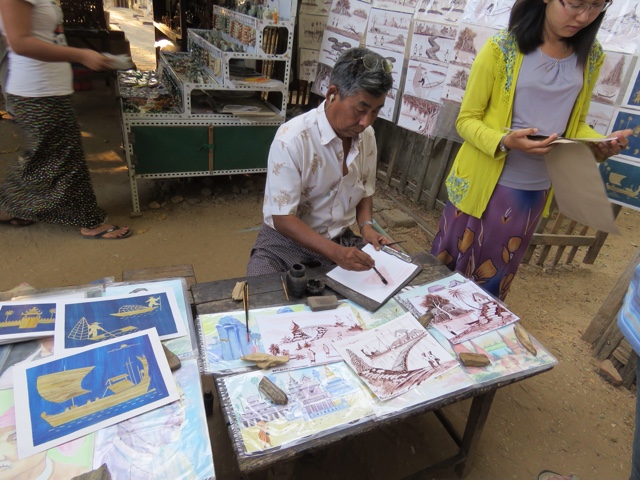
This gentleman was doing razor blade painting.  The pictures to the left were made by an elderly lady out of tiny strips of bamboo.
The people of Salay found this Buddha floating down the river a couple of hundred years ago and built a pagoda for it.
Animal monuments welcome you to many pagodas.  
These two stupas are such a contrast with one covered in grass and weed and one in glittering gold leaf within the same complex
A river logging operation 
Pagoda sitting high on the hill offering panoramic views.
The white elephant is a widely worshiped religious animal in Myanmar 
Misty view from the top of the hill with the long staircase visible in the foreground.
This wooden bridge was a bit precarious looking but we thankfully crossed successfully 
Band for the elephant dance.  Most of them were chewing betel
Traditional elephant dance was very colorful and entertaining 
The costume is apparently quite heavy and the two men inside are well trained.  There are competitions held between the villages.
A Myanmar "marina"
Temples in Bagan are stunning and in amazing condition when you consider they are almost a thousand years old.
Mom and child taking a nap in the heat of the day
The whole skyline of Bagan is punctuated with temples 
Bagan sunset
Bagan suffered a large earthquake last year and many monuments suffered significant damage 
Monk giving us a candlelight blessing 
Shwezigan Pagoda constructed of beautiful white stone
Wonderful carvings that have survived the centuries 
Crowded market in Bagan
Vendors sit right up on the table with their goods.  Vendors were quick to show us their unusual products.  Bargaining was expected and was quite fun.
Some of the temples and monuments were in clusters which were like eye candy with a picture in every direction 
No barriers anywhere and very few people which made it even better
A traditional marionette puppet show was very entertaining 
This man demonstrated how to climb and harvest the juice from the jaggery Palm tree.  The juice is very sweet and they then ferment it making it into wine or cook it down into sugar.
This small house was home to seven. No indoor plumbing here.
This is the kitchen for the above home
The 18day old baby sleeps here during the day while his mom is working
This man is making the bamboo forms for the lacquer pots
Some lacquer pots are flexible and are made from woven horse hair. This girl is weaving each hair one by one.
Each lacquerware product is hand painted.  A very labour intensive process that once one sees how quality products are made it is easy to understand the prices.


Mingle and Magwe


Our first stop of the day was at Minhla which was the site of a great battle during the Second Anglo-Burmese War.  The king had built forts along the river to protect Burma from the English but did not take into account that the English had the ability to travel by land so thus the Burmese were defeated in 17 days.  The fort was interesting to visit but the most fascinating part of the visit to this town was the extensive market.  Most of the items for sale were food and as this is not a big tourist town this is where all the locals shop each day for their needs.  Once again the vendors were happy to show us their wares well aware that we were not going to purchase anything though some of us did buy longyi to wear later.  Some of the smells such as the spices were wonderful and some of the smells did not stir the appetite though they definitely were of interest.
Back on the ship we had a demonstration on how the locals wear the longyi.  This is the traditional outfit of the locals, particularly the men and is very cool and versatile as well as being very cheap.  In Myanmar as soon as we arrived we noticed that most of the women and children had a beige colored paste on their faces and wondered what it was.  We learned that it is Thanakha and is from the bark of a tree.  Not only is it a sun block but it apparently has great medicinal properties for problem skin.  May be a coincidence but he people of Myanmar have wonderful complexions.  The men only wear it in the privacy of their homes as it is not regarded to be manly.
Our next stop was in Magwe where we first visited the Mud Volcano which the locals believe houses fire breathing dragons but we skeptical tourists found to be the first place we would have like to have passed on.  Interestingly it was also the first place we came across beggars.
We visited a park to see a statue of General Aung San Bogyoke where a group of high school students turned us into the attraction before going to the Myathalon Pagoda on the bank of the river.  We were luck enough to arrive there during a novication ceremony where four children were going to become monks and a nun the following day.  This is a very proud time for parents and a great celebration is held including a parade.  The parents were eager for us to take their children's photos.
The fort in Minhla built by Italians which failed to protect he invasion by land.
One sees all sorts of things being pushed down the roads.
The vegetables looked fresh and clean though I could not help but wonder where they had been washed.
Cooking over open fire in the middle of he market 
Wonderful spices
All kinds of dried foods,some not resembling anything familiar 
Stacks of betel leaves to make the betel nuts for chewing.  The more rural we get the more people we see chewing the nuts.  The roads are stained with red from where they spit out the remainder.
Frying up local delicacy.  They smelled really good.
Spices and beans.
Myanmar recycling.  These buckets are made from old tires.
These sandals are also made from old tires and cost the equivalent of one dollar and last up to three years being worn every day.  Pretty good value.
Dried fish and shrimp.  Dried shrimp is used is many of their local dishes and we are getting to really like it.
Local truck on the way to market
A bridge to a house.  In rainy 


Pyay

Pyay sits on the eastern banks of the Ayeyarwady River and was established by the British Irrawaddy Flotilla Company as a transshipment point between upper and lower Burma in the late 19th century.  The city is home to more than 80 guided pagodas.  We went to visit the Payagi Pagoda which not as large as the one in Yangon to us was much more appealing.  The stupa is covered in gold and the whole pagoda glitters.  We were the only tourists visiting and the locals took delight in taking our pictures.  Our guides are filling our heads with information regarding the Buddhist way of life which is quite fascinating. From one area of the pagoda one looks directly over at a ten story high sitting Buddha rising hig out of the tree line.
We then went to visit Bawbawgyi Payi which is a cylindrical shaped stupa built of brick and plaster and is the oldest stupa in the area.  It still has a gold top where loyal followers make their contributions in gold.
Traveling along the river is fascinating.  Right now the river is at its lowest depth and is only six feet deep in many places so navigation is very tricky and impossible for some boats at this time of year.  This ship only draws four feet of water making it possible to go up the river under these conditions though there is is often a crew member on each side of the boat measuring the depth with a stick.  Very high tech!  The river is dotted with huge sandbars which often have small nomadic villages set up on them of fishermen and farmers.  Land that is under water in the rainy season is actively farmed at this time of year.  The sides of the river are often steep sand banks which indicate how deep the river runs during its high point.  In Myanmar the people do most everything by hand and it is fascinating to watch the workings on shore from the boat.  Ox carts carrying loads are a frequent sight and a welcome picture opportunity.  The river itself is busy with boats large and small.  The larger boats and barges are dredging stones from the bottom of the river which are then used in building and are worth a lot of money so this is quite lucrative. A few of the smaller boats are fishing but they mostly seem to be for transportation to get them to their homes and work.

In Myanmar children serve as nuns or monks several times during their lives, sometimes just for a week at a time.  Some serve for a lifetime.
Stupa in Paya. We have seen nothing but clear blue skies.
Within he temple complexes there are dozens of Buddha statues for people to worship before.  Some have different significant meanings, for example some are believed to contribute to wealth and some to fertility.
Around the stupa are eight points representing the days of the week with two for Wednesday.  Buddhists put great significance in the day of the week that they were born and worship at the appropriate shrine pouring water over the Buddha for blessing.
Ten story high Buddha rising out of the trees
The local people drink their water from clay pots.  They keep the water cool plus the sediment settles to the bottom so they only drink from the top two thirds.
Oldest stupa in Paya, made of brick but still topped with gold
Gold umbrella at top of stupa where the believers add gold offerings every five years
This gorgeous flowering tree ,the lumbini ,at the site of the stupa is much reveered as it is believed the Buddha was born under one of these rare trees.  The flowers have the most beautiful scent.
Family transportation complete with sun protection 
The AmaPura tied to the bank
Nomadic lifestyle on the sand bars
Small boats for transportation to jobs and market.
Farming on top of the sandbanks.
Small pagodas dot the river.  Some seem to be in the middle of nowhere.always somewhere to go to worship.
Bathing in the river.  Makes one very thankful for hot showers.
Ox cart taking a crop along the river bank
A family enjoying a rest from the heat in the middle of the day.
Fishing nets set up along the shallows of the river
Farming on the fertile land that is under water during the rainy season
Local women doing their laundry.  Everyone we have met has been clean with beautiful shiny hair.
Clothes drying on the river bank.
Sorting hot peppers on the side of the river
Locals coming to take pictures of us.  This is quite common here as we are the oddity.