Friday, 10 February 2017

Inle Lake

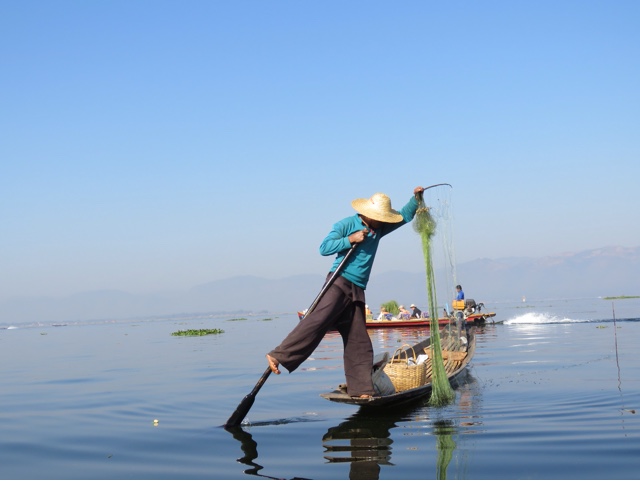
Inle Lake was definitely a highlight of our visit to Myanmar.  Situated in Shan state 150 kilometers south of Mandalay it is an oasis of islands and islets that has a score of  floating villages built over the water on stilts and supports a population of about 70,000.  The fishermen on the lake are famous for their ability to stand on one leg while rowing with the other in order to have their hands free for fishing.  It was certainly entertaining to watch.  Many of the inhabitants are farmers and large parts of the lake have been reclaimed and are now orderly rows of produce reached by boat. The villages all seem to have a plan with orderly waterways instead of streets and in places there are small bridges crossing over so one can get to neighbors. Workshops occupy their places in many of the villages with weavers,silversmiths, cigar makers, paper makers and more carrying on traditional crafts to support their families.  A large market is held every few days which we were lucky to participate in.  What bedlam.  The lake has become quite the tourist destination in the last few years and we were told that they are presently building ten new large resorts.  We are so thankful that we visited now because that large an influx of people will definitely take away from the magic of this very special place.

Market day on the way to Inle Lake.  This is a pile of tapioca.  Was a surprise to most of us.
All types of dried fish if one wants to be adventurous.
Shan State area of Myanmar is where the bulk of the tea is grown.
Local markets are held every five days and keep moving around.  Loud and busy.
So many of the clothes actually are handmade and on treadle machines at that.
These are local taxis and seat two persons sitting back to back.
Shwedagon Yan Pyay Monastery 
The glass mosaics inside the wooden monastery were quite stunning and certainty gave this wooden monastery more draw than others we had visited.
Many young monks were studying intently while we were on our visit
The cave pagoda next to the monastery had hundreds of niches where individuals could apply and place their own Buddha for a limited period of time.  There is apparently quite a waiting list.

A wine tasting at Red Mountain Winery only showed us that Myanmar has a very long way to go before they will be known for their wine production.
Sunset at Inle Lake 
The sun setting with he gardens in the foreground was quite magical 
Fishermen on the lake have an amazing sense of balance as they row the boat with one leg while trying to catch fish with their nets.
A trip to he lake is not complete without watching the cone fishermen 
This gentleman was not only a performer but he also caught a fish
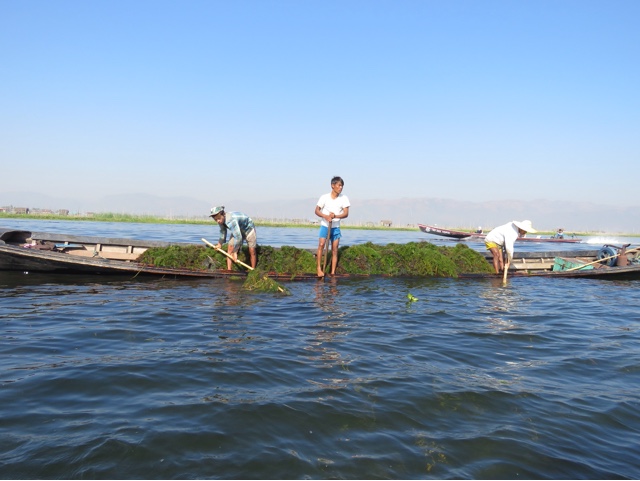
Harvesting the weed from the lake will get these men 15 dollars a boat load which takes about four hours.
This picture is for you Kayla
The long narrow boats were our mode of transportation for our time at Inle Lake 
Agility and balance as well as creative modes of carrying items are a necessity here
This man was filling the locals oil jugs for cooking 
Traditional Shan head dress
This little girl asked Eric to take her picture and was delighted to see the results 
The local barber was set up right in he middle of the market
A total traffic jam of boats as all the locals come to market
Shopping done possibly waiting for family members
The Buddhas in this temple have been so heavily covered with gold leaf that they now look like round balls.  It is unfortunate as from the pictures of the originals which are hundreds of years old they were beautiful.
Rickety bridge cross the water roads all over the lake so residents can get about the lake villages.
This woman is extracting the fibers from the lotus stems which they then weave into beautiful clothing.
Winding the lotus thread onto large spools for the looms.
A project in progress.
This elderly lady is winding the silk thread she has dyed.
The houses are built on stilts and the home owners park their boats underneath.
The waterway is their yard and street
Young children sit out alone and not a life jacket to be seen
Fascinating world.  Most all homes had satellite dishes.
The villages were set up in a pattern
These young women worked in the cigar factory and each make approximately 1000 a day for the royal sum of four dollars a day.
The gardens in the lake have been built up over time and no fertilizer is used.
Farmers hard at work
Sixty percent of Myanmars tomatoes are grown in Inle Lake
Bamboo reeds are ready for a new crop of tomatoes
Notice the power lines.  Septic tanks were also put in in the nineties and are emptied regularly.
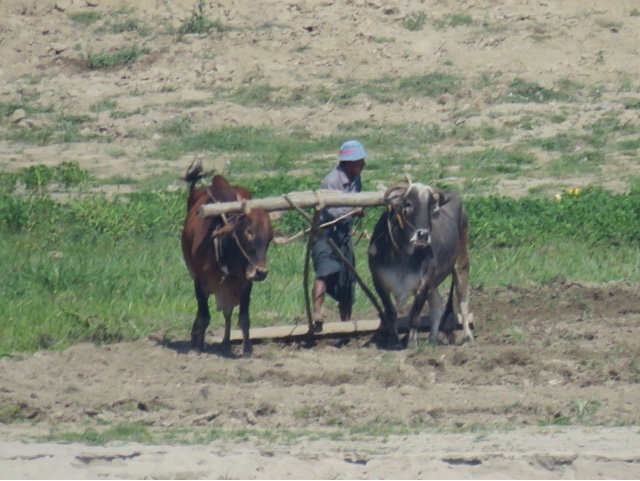
A farmer taking his oxen down to the lake to cool off
Dinner with friends after a wonderful day exploring life on the lake
Our boats await us to take us out on our next adventure 
Advertising signs seem to pop up all over buildings in Myanmar even in remote areas perhaps due to the lack of television.
We went up a long narrow arm of the lake with small Rapids where the locals had built small risers with sticks and branches.
The little village of Indein was so picturesque.  It was situated on the bank of the lake.
A long narrow arm of lake runs right through the village.
We saw dozens of people doing their laundry in the river and the lake over the last two weeks but this was the only time that we saw a male actually carry out this chore.
The fences were so orderly and all made of sharpened bamboo so that the birds would not sit on them.
This industrious fellow did beautiful art work with what little he had to work with. His English was excellent and he was a delight to speak with.
The village is famous for its large collection of pagodas which date back to the 16th century. It was like a miniature Angkor wat without all the people
Many of the pagodas have vegetation growing from them
Shan head dresses come in handy for balancing your wares on your head
Eric enjoying exploring and snapping pictures
Stretching up the hill are thousands of stupas of all ages in all states of repair.  These are erected by families.
At the top of the temple the stupas look like a crowded chess board
These adorable children spontaneously entertained us with a song
Stalls set up along the pathway.  Thankfully he people of Myanmar are not at all pushy so one is not harassed 
Mom and child sharing some time together 
Collecting sand and dirt from the bottom for the lake gardens
It was a bit of a surprise to have this coming towards us in the village 
Coming home from market
Traditional silversmith shop still making jewelry today
Demonstrating the art of paper making
Finished product with embedded flower petals 
This lady is making paper umbrellas for sun shade,a popular item In Myanmar 
We met with some women from the Padaung tribe who are famous for wearing the rings on their necks.  The girl on the left is only 15 so does not have as many rings yet.  Except for the bottom five rings which the woman on the right has the rest is one continuous coil. It is changed as the girl grows until she is an adult and then she gets the separate one when she gets married.  It is loose and can move for sleep.  Once girls have these coils they have them for life.  There was one woman in the tribe who decided to be a nun and as nuns can have no adornments she had the coil removed and it was well over a month before her neck could support her head.  They start the coil at age 9 or 10.
This lady kindly shared her experience about the rings.  As was her tribal tradition she also had them wrapped below her kness as they believed this made your legs stronger.
One of the monuments inside the wooden monastery on the lake.  The gold and mosaic work was beautiful.
The inside of this monastery was definitely a treat
Do you suppose they are racing
Heading back to the hotel after a most enlightening adventure 


Wednesday, 8 February 2017

Yandabo to Mandalay

Continuing up this fascinating river our next stop was at Yandabo which is famous for being the location where the Anglo-Burmese peace treaty was signed in 1826 but today is better known for its pottery making.  These pots are fundamental to the people of Myanmar to store water and food and are transported all over the country.  One persons can make 30 to 50 pots a day and each household has their own unique stamp.  To fire them they are arranged in a large circular pattern and covered with a large pile of ash, straw and wood which is set on fire and reaches a temperature of 1200 degrees for several days.  Had a lovely evening celebrating Steve's birthday complete with cake and a Myanmar serenade.  
February 4th we spent a lazy morning up on deck observing the life on the river and on shore.  There is always something to look at and one does not spend much time sitting in one place as both sides of the river offer different glimpses all the time.  After lunch we arrived in Inwa, which was the capital of the Burmese kingdom for more four centuries and is located at the confluence of the Ayeyarwady and Myitnage Rivers.  We explored the area by horse drawn buggies passing huge rice paddies and stopping to go in the Bagaya Monastery.  Built of teak it is beautifully adorned with artistic works of the Inwa Era but somehow perhaps due to its darkness it did not have the same beauty as many of the others hat we have visited.  Afterwards we went to Amapura to visit the U-Bien bridge, which is 1.2 kilometers long and built from teak planks from the dismantled palace is said to be the longest of its kind in the world.  We went out in small boats to watch the sunset at the bridge.  With a glass of champagne in hand it was a spectacular sight and a sunset we will always remember.
The next morning in Sagaing started off in a most memorable way with a food giving ceremony to the local Buddist monks from the crew and passengers of our ship.  A long procession of monks filed by and we're all given food and necessities as is the tradition in the Buddist faith.  It was very touching.  We the went to a nunnery where we met with several nuns and through an interpreter were able to discuss their way of life.  Some had become nuns as young as nine and we're now in their eighties.  Fascinating.in a day full of Myanmar culture we then went to a monastic education school which is a free school for all who can not afford as well as an orfanage for those with no parents.  A lot of the students come from monasteries and nunneries.  Started in 2003 with 31 students they now have 2556 students.  Classrooms are minimal but students seemed to be paying attention and learning.  It was heartwarming to see that teacher, many of them volunteers are trying to educate the young. We concluded our visit in Sagaing with a visit to a hilltop pagoda which gave us a panoramic view of the river and all the multitude of religious monuments.
A short ways along the river we sopped at Mingun where we first visited the the Mingun Pahtodawgyi which if it had been completed would have reached a height of 500 feet.  Started in 1791 it was badly damaged in the earthquake of 1838 but is still the largest brick base in the world.  We had a visit with the towns doctor who is their first and only opened his clinic two years ago in this town of sixty thousand people after a Japanese rotary club paid his way  through medical school.  His wife runs a small souvenir shop to help fund the clinic.  How lucky we are.  We then went to visit Myatheindan Pagoda which was built in 1816 and painted white as a representation of the mythical Buddist mountain Mount Meru.  The seven wavy terraces around the pagoda represent the seven mountain ranges surrounding Mount Meru and are absolutely stunning.  We climbed up the 88 steps for a view before taking an entertaining tuck tuk ride back to the ship so we could sail to our final destination of Mandalay.
We spent the last day of our river tour exploring Mandalay.  A city of over 1.6 million people it is one of many contrasts.  Modern high rises sit next to derelict old buildings giving evidence to a wide spread in economic positions.  Motorcycles are everywhere and the city is hot and dusty.  We made a visit to one of the remaining gold leaf workshops and the went to see the Mahamuni Buddha which was originally bronze but has been covered by thick layers of gold by the faithful.  This was the first pagoda that we visited that only men were allowed to go up to the Buddha.  We also visited a woodcarving,tapestry and puppet making workshop.  It was fascinating to see these craftsmen up close and be able to see all the finished products.  We stopped at Kuthodaw Pagoda which is said to contain the worlds largest book as it has Buddist scriptures inscribed on 729 marble slabs with each slab housed in a separate pagoda.  It is quite an impressive sight.
We completed our visit in Mandalay with a sunset visit to the monastery on the top of Mandalay Hill to enjoy the panoramic views.  It was really interesting to engage in conversation with some of the young monks who were there as they were eager to practice their English.  Tomorrow we leave the Ayeyarwady River behind but look forward with great anticipation to Inlay Lake.


Working on the foot driven lathe this lady makes 50 pots a day.
This woman was the owner of the operation and pounds the bottom of each pot by hand.
With an open engine and woven bamboo sides on the back this truck was quite appealing
This kitchen was actually bigger than most that we saw.  Note the stove with the kettle on it.
The village turns out thousands of pots yearly and ships them all over the country and some internationally 
Every business needs a supervisor and this gent seemed to be doing a great job
Life can get boring when mom is doing the laundry
This was our transportation around Inwa
Sunset at the U-Bien Bridge 
Reminded me a lot of ET
Every last moment was breathtaking 
A visit to a silk weaving factory was really interesting and the work was to intricate and time consuming 
The monks coming for their morning blessing. Not a word was spoken 
Eric presenting an offering to the monk
Nuns young and old at the nunnery
Kindergarten class at their lesson outside at the Monastic school
Grade five class not all so hard at work
Not quite the classroom facilities our children are used to
Lion seems to be guarding all the gold
Religious monuments dot the landscape in Sagaing
Either everyone does their laundry on the same day or perhaps it is an out door landramat 
Dry land storage just waiting for the rainy season to launch the boat
The stilts on these house indicate how high the water levels get in the rainy season 
These workers are all carrying hoses. Quite the irrigation system
Nothing seems to be done the easy way in Myanmar 
Fish nets stretched across a tributary with homes in the background and livestock in the foreground 
Largest brick base in the world in Mingun
Even cows need to get around 
A local makeup shop
Various fried goods. Some were small fish and some were worms. Yum
This pagoda was breathtaking. Looked like a giant wedding cake
Steve, Tina, Eric and I halfway up
Some entertaining Burmese dancers 
Pounding gold into gold leaf
Worshipping and putting gold leaf on the Buddha 
Sisters dressed up for their brothers novitiation ceremony
Craftsmen at the wood carving shop
Beading puppets
Tapestry work
Finished puppets


Wooden monastery 
Worlds largest book
One page of the book
Monastery on Mandalay Hill
Beautiful tile work and contrasting colours
Feast for the eyes
Friendly young monks wanting to engage in conversation 
Pagodas lit up like Christmas trees