Wednesday, 27 September 2017

Athens

Disembarking from a wonderful week on Windstar we now have a couple of days to explore Athens more.  Eric and I took advantage of the beautiful weather and spent some more time exploring the lanes of the Anafiotika just below the Acropolis.  The narrow lanes and steep stairs with the small whitewashed homes are an appealing escape from the hustle and bustle of the city yet only steps away.  Further exploring took us to the Panathenaic Stadium more often referred to as the Olympic Stadium.  Built originally in the fourth century BC it was rebuilt by th Romans in the second century AD using the same Pentelic marble used in the Parthenon.  It was restored to its Roman condition in preparation for the first modern Olympics in 1896.  In 2004 it provided a grand finish for the marathon in the Athens Olympics.  The stadium seats 45,000 people and it was quite something to trod the ground where so many athletes have competed over the centuries.  We strolled through the beautiful National Gardens and watched the changing of the guards at the tomb of the unknown soldier in honor of the great battles in Greek military history.
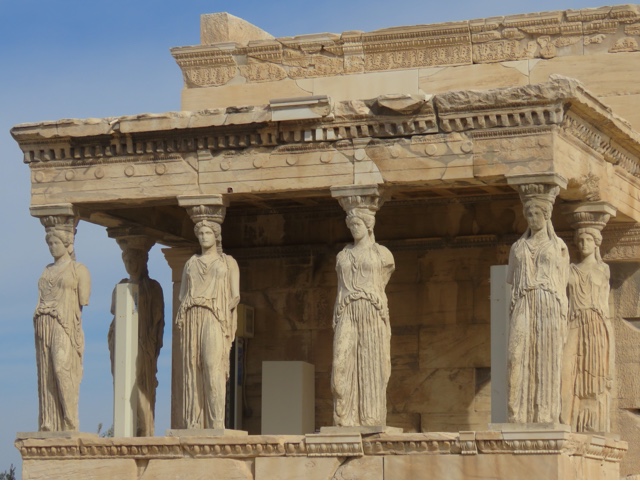
On our second day in Athens we started our Rick Steves tour with our visit to the Acropolis.  The Acropolis has been the heart of Athens since the beginning of recorded time.  Athena, the patron goddess of the city was worshipped here from 800BC on but everything changed in 480BC when the Persians invaded Greece.  The citizens of Athens evacuated and all the temples on the Acropolis were burned to the ground.  In the end the Greeks found themselves victorious.  By 450 BC Athens was at its peak of power and as the Acropolis was a blank canvas, led by the visionary architect Pheidias the Athenians built a complex of super sized ornate temples on the Acropolis with the largest being the Parthenon.  Soon after entering the site we were treated to the site of the Theatre of Dionysus which is a 5000 seat amphitheater built in the Roman times. Originally erected in 161 AD restoration has returned it to such a spectacular state that it is used for perfs today and in fact they were doing sound checks when we were there.  Winding uphill one passes through the buildings of the Propylaea to step out on to the top of the Acropolis where the Parthenon is revealed in its full splendor.  There is massive preservation work going on so there was a lot of scaffolding in places but not enough to take away from the work of art that this ancient temple is.  Its sheer size is amazing when one realizes that it was built nearly 2500 years ago. What an engineering feat.  The nearby Erechtheion with its porch with six maiden statues was a favorite of mine.  The crowds were quite overwhelming as the morning progressed but definitely a visit that could not be missed.  We went to the Acropolis Museum which is an architectural wonder in itself and holds a wealth of artifacts uncovered from the site.
After a lunch at a sidewalk cafe Eric and I explored the ancient Agora which was truly the heart of ancient Athens.  This was the hub of all commercial, political and social life in the city.  Today it remains a very active social and economic area loaded with shops and restaurants around the actual ancient Agora site.  While the ruins of the homes and shops interspersed with ancient statues are amazing the highlight was the Temple of Hephaistos which was completed in 415 BC. Much of the roof is still intact as are many of the reliefs around the top.  Simply magnificent.

A view of Athens from up on the Acopolis
Narrow staircase leads between two homes in the Anafiotika.
Stone pathways take one even deeper into this delightful array of homes
Such a peaceful reprieve from the city which is only steps away
Beautiful marble stadium
Eric is trying out one of the chairs reserved for Royalty to watch the games from.
Statue in the stadium depicting the young athlete ready to compete and the elder who will judge. Left from Roman times.
Over 2000 years old this is the passageway through which the athletes entered the stadium 
View of the Parthenon from the top row of the stadium 
Greek soldiers in traditional dress during changing of the guard.  Love the Pom poms on their shoes.
Tomb of the unknown soldier 
Part of the theatre at the Acropolis 
Entrance to the Acropolis through the Propylaea 
More shots of the grand entrance 
Theatre of Dionysus
Just a small part of the Parthenon 
Sheer size is hard to impart
Temple of Caryatids 
Six beautiful maiden statues. These are replicas. The originals are in the Acropolis Museum 
Original maiden statues from 420 BC
Lion statues from BC
Original reliefs from the Parthenon now housed in the Museum 
Statue of Hadrian a Roman Emperor AD 117-138 who financed a large building program in Athens
Beautiful carvings in the Temple of Hephaistos in the ruins of ancient Agora 
The magnificent Temple of Hephaistos 

Tuesday, 26 September 2017

Patmos and Santorini

Patmos is a World Heritage Site and is known world wide as the sacred island.  Our first visit via a scenic route along the coast was to the Grotto of St John which is a simple cave where he is said to have spent 16 months in exile and where he wrote the  Book of Revelations.  The cave now has a small chapel attached and is a place of pilgrimage.  As a mass was being conducted when we arrived we elected to return later in the day which turned out perfectly as we were the only six in the cave and we were able to sit and just soak up the atmosphere.  It was a very special feeling that I am not able to put into words. We also visited the Monastry of St John built in the 10th century which has a very impressive collection of jeweled chalices,crowns and crosses icons, religious paintings and old manuscripts.  In the charming hilltop town of Simtra we visited an old Greek home which has been in the same family for eight generations and met the spunky 93year old owner.  We completed our visit here with a lunch at a family run Taverna where we were entertained by the Greek dancing of two of the brothers.
Approaching Santorini early in the morning one cannot help but be impressed with the towering cliffs topped with white houses spilling down from the top.  Our first visit was to the scenic town of Oia which is what everyone thinks of when they think of Greece with whitewashed houses and blue domes draped over a steep slope at he top of a steep cliff.  Each building runs into the next giving you the feeling that they are all connected in some way.  Narrow walkways take you from one to the next.  At the top of the cliff are winding little lanes lined with shops and restaurants with breathtaking views over the ocean and surrounding islands.  We arrived early in the morning which was perfect because the town soon turned into perfect bedlam with wall to wall people.  We visited three wineries on the island which was interesting as their vineyards are all in volcanic ash and the vines are kept small and cylinder like to keep in any moisture that might occur in this very dry climate.  The wines were passable with their most notable being the Vinsanto which is a desert wine.  It was a fun couple of hours but we will not we in search of these wines to drink in he future.  A visit to Fira revealed another whitewashed town tumbling down the hillside.  Makes one wonder what would happen if there was an earthquake and one started to slide.  A long pathway leads up from the port and you can take donkeys or ride the cable cars.  After a delicious lunch with a panoramic view we chose to ride the cable cars down as the thought of sliding over the donkeys head was not appealing.  A beautiful island but with the overwhelming crowds a short visit was enough for us.

The picturesque harbor town of Patmos
Courtyard of the Monastry of St Johns
Being entertained while we enjoyed lunch at a small family taverna. Grandpa was sitting at the bar with one of these gentlemens sons on his knee.  Three generations at least.
A store front on the street of Patmos
Arriving in Santorini as the sun was coming up. Looked like snow on a mountain from a distance.
The picturesque town of Oia.
Buildings were built right into the rocks.  The dome shaped roofs were used for water collection as this is such a dry island.
Still the occasional old windmill survives to add to the quaint beauty of this island 
A very unique looking book store.
Oia carries on up th hill as well
A charming private back patio
The narrow streets of Oia before the hordes descended 
A happy interloper 
A visit to a wine museum had this myth which I thought was quite lovely 
Believe it or not this is a vineyard.  The vines are planted in volcanic ash and are kept low and cylinder shape to retain moisture. They are only watered for the first two years and then they are left on their own in this very dry climate.
This is the interior of the volcano that formed the island of Santorini and those surrounding it
Coulourful flowers against the bright sky add to the beauty
The capital of Santorini, Fira
Panoramic of Fira
Donkey men waiting in Fira to rent their donkeys to carry people down to the port or up for six euros per trip.
Cable cars which are a more popular option for getting up and down from Fira
Fira from the cable cars
Farewell to Santorini 


Friday, 22 September 2017

Kusadasi Turkey and Ephesus

Today we visited country number 55.  Though the visit was short it was very memorable and full of highlights that will last a lifetime.  We arrived in Kusadasi where a relatively new cruise port has been built as ships will no longer venture to some of the other Turkish cities due to the instability.  Other than a visit to a carpet factory to see how Turkish carpets are made and of course being pressured to buy (we resisted) our time in Turkey was spent at Ephesus.  Ephesus was the capital of Asia Minor and after 150 years of extensive excavation the city's recovered and renovated structures have made Ephesus the most complete classical metropolis in Europe and there is still 82% of the city to be uncovered.  Entering the ruins one feels a connection to history.  To walk on he same stone pathways that the Roman trod on before the time of Christ makes one realize how connected we all are.  Walking through the ruins of the city one sees the baths where one cleansed themselves before entering the city.  The Odeon which is a 5000 seat theatre which was used for municipal meetings and such is in fairly good shape with ornate marble columns and carved ornamentation.  One passes by the ruins of the temple, hospital and some fountains before entering on to Curetes Way which was the cities main thoroughfare and takes you past small shops, terraced houses, the brothel, the Temple of Hadrian and the public latrines.  The way leads you to the impressive Library of Celsius which has a large facade which is very ornate yet the interior itself is quite small as few could actually read so there were not that many scrolls kept.  Further on are the ruins of the large market place and then you arrive at the Great Theatre which was built BC and reconstructed in AD 41. This theatre hold 25,000 and has magnificent acoustics so no sound systems are used for performances that are still held here periodically today.  We also visited The Virgin Mary's house as legend has long attested that St John brought Mary to Ephesus near the end of her life. Another stop was at the ruins of the Basillica of St John where his remains lay for many years.
Our evening in Turkey was magical.  We returned to Ephesus for a private dinner at the base of the lit up library accompanied by live classical music.  Handed a glass of wine as we walked down the  Roman road leading to the library and being treated to a dinner with first class service in such a historic place with so few people is an experience that will be hard to beat.  To add to the magic there was an opera in the grand theatre to which we were invited.  Opera fans or not to sit on what I must say were very uncomfortable rock seats in a theatre thousands of years old was a privilege and a experience we will never forget.


The port city of Kusadasi 
Virgin Mary's house reconstruction on the unearthed foundation 
Traditional Turkish wall of wishes. One leaves a private wish in hopes it will be fulfilled 
Ruins of the Odeon Theatre 
Temple ruins with statues in the background 
Statue of Nikes
Grand walkwY to the city
Beautiful mosaic floors that have been uncovered in the small shops
Walkway to the public latrines
Male public latrines which were also a place to visit and share a glass of wine. The indentation in front held water with which they cleansed themselves.
Front of the Library of Celsus
The Grand Theatre
A bronze discovered at Ephesus done in 200 BC
Tomb of St John
Woman making a traditional Turkish carpet
Welcome to our dinner at Ephesus 
An event to remember
Incredible lighting
It just got better and better
The opera in the Grand Theatre