Thursday, 5 October 2017

Mystras, Mycenae and Ancient Epidavros

Over the next few days we visited three more of Greece's magnificent historical sites however it was not all history.  Our days were spent strolling the streets or along the shores at Nafplio which was our base, enjoying wonderful food in little sidewalk cafes, wine tastings with some ouzo and tsiporo thrown in for good measure.  We had a wonderful Greek dinner in a little family taverna with Mom, sister and brother doing all the cooking and serving. We were entertained with Greek music through dinner and then the dancers arrived.  By the end of the evening no one was allowed to remain seated and a fun time was had by all as we were taught a simple Greek dance.  Interacting with the locals is such a fun part of the trip.  All of the places we have stayed are family run and it is such a warm feeling.  Our guide is British born but married a Greek man and has lived here for over 30 years. Maria has been full of stories of Greek life from birth to death, jobs,the economy, religion,history and any thing else we might want to know.  What a personal way to learn about a country.  We have stopped at little places along the way that we would never have found on our own which has made this tour so much more worthwhile.
Mystras is the most important Byzantine site in Greece as it was here that the Byzantine Empire had its last stand before being taken over by the Ottomans.  At one time home to 15,000 there are now only six old nuns left living in the Monastry.  Built on a steep hill we started at the top and visited verbal of the churches on the way down to view ther frescoes which were painted by some of the Empires greatest artists.  A short visit to Sparta which dominated Ancient Greece in the fifth and sixth century BC was very anticlimactic as it was abandoned in the 13th century and its buildings were dismantled to build Mystras.
Mycenae was the oldest site we visited dating back to the 15th century BC. One enters through a large lions gate. A large civilization once lived here and large grave circles have been excavated which have revealed a large amount of treasures that were buried with the bodies and tell a lot about life 3000 years ago.  Amazing.
Epidavros was a site built more than 2500 years ago that the sick would go to seeking the help of the priests who were the early doctors. The ruins themselves are not that remarkable but the theater built nearly 2500 years ago is in magnificent condition and is even in use today for special performances as it has near perfect acoustics.


Leading to the church at the top of the hill at Mystras 
Ruins of the church where inside beautiful frescoes remain
The monks eating hall.
Remains of a three story house which show historians that people of wealth lived in this area
This rare frescoe depicts the birth of the Virgin Mary with her mother Ann
Archways leading to yet another church 
The frescoe above the entrance to this courtyard has survived the elements for hundreds of years
This is the Monastry where the six elderly nuns live up on the hill.  There is only a path to access it
The day we were in Sparta was the day of the Spartathalon which is a 250 kilometer grueling run
These are the uninspiring ruins of Sparta
One needs to eat and this was a delicious grilled calamari 
Eric was very pleased with his pork kleftiko
Large beehive tomb at Mycenae from the 15th century BC
Gold ornaments found in the grave circles from 1600-1500BC

Ceramic burial vase as in above illustration. This one dates back to 1050 BC
Canaanite jars recovered from a tomb 1400 BC
6th century BC ceramics also recovered from a grave
The lions gate entrance to Mycenae
One of the grave circles that was excavated where all the treasures were found
Golden treasures


The steep stairs of Nafplio where we spent time between visits to different sites
Group dinner at a family taverna
Greek dancing with a couple of good sports participating 
Surgical instruments used at ancient Epidavros 
The athletic stadium at Epidavros where competitions were held
Part of the ancient site under going restoration. Very tedious and expensive work
The 2500 year old theatre 
View from the top. Fabulous sound when someone clapped from center stage


Kastania and Monemvasia

Traveling along we stopped for a visit at the charming village of Kastania.  A traditional Mani town wedged in a gorge it was a powerhouse during the Greek War of Independence in the 19th century but is now a sleepy little tow with almost as many churches as residents.  Built on a steep hillside it was a good workout to wander through the narrow allies which seemed empty to people.  The churches were open and some of them had the most beautiful frescoes. One thing we noticed that this town did not have any of the graffiti that is so prevalent in much of Greece.
Our next stop was a definite highlight.  Monemvasia is a gigantic rock that juts up from the sea and is connected to the mainland by a skinny spit of land.  This beautiful walled town with the remains of an upper town scattered on the peak high above is like stepping back in time.  Narrow stone pathways wind among buildings and homes in various states of repair with inviting little restaurants offering small patios with panorama views over the town and ocean.  We seemed to have hot this at a perfect time as there are not too many tourists and at times we had the alleys to ourselves which made it even better.  In the late evening when the lights came on it was almost magical.


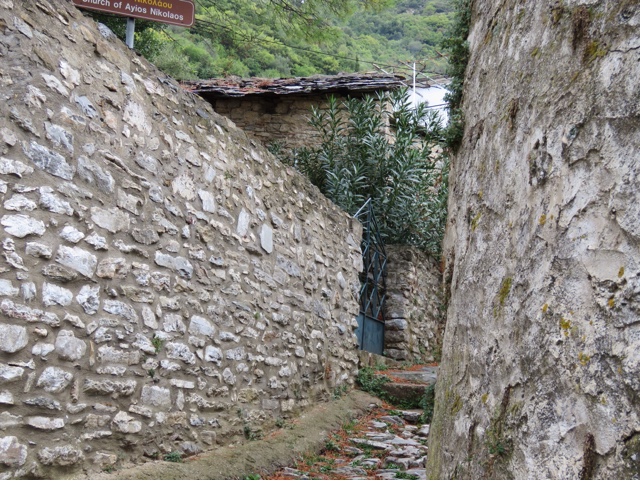
Perched on a hillside this once bustling town has been abandoned by the young seeking greener pastures and is now a town of elders with many of them gathering in the town center at the only cafe for coffee and visiting daily.  How they get around on these steep rocky paths is beyond me.  One elderly gentleman was in a wheelchair and his elderly wife helps him around this town that is definitely not handicap friendly.
Another pathway leading to some homes.
One of the many local churches.  For a small town there is a large number of churches as many families built their own.
Beautiful murals on the walls of the Greek Orthodox churches tell the stories of Christ
This little town spills down the hillside.
A lunchtime stop at this seaside restaurant provided us with the fresher fish and calamari possible as the gentlemen on the left were catching them and they were being cleaned and immediately put on the grill before being delivered to our table.  Delicious.
These little red fish were quite delicious.  Once you removed the head and spine you ate the rest and they were crunchy with some sweetness to the taste.
The rock of Monemvasia is often compared to the Rock of Gibraltar 
  
Monemvasia means single entry and this is the only way into this charming walled 13th century town
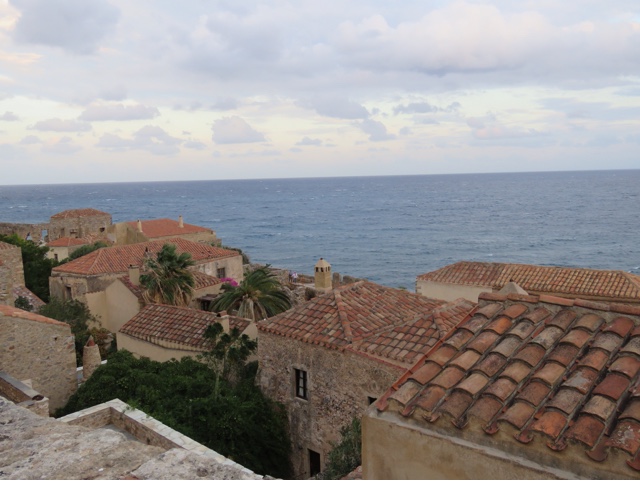
Stunning views in every direction 
The ancient homes with their red roofs toppled down towards the sea.
The towering rock was an impressive backdrop 
 The ancient upper town sits high on the rock looking down on the lower part
 Pedestrian only, narrow alleyways give one lots to explore 
Greenery and flowers make for inviting entrance ways.
The Main Street of Monemvasia with charming shops and restaurants 
Tourists out exploring
Cats must be the national animal of Greece.  They are absolutely out of control. Apparently they do not belong to any individual but people do put food out on ther porches so they are well fed. There was not one restaurant that we were in that did not have at least one cat wandering around and some had several.  You can imagine that this was not our favorite memory of Greece
The Main Street in the evening 
Looking high up the top of the rock
One can still walk along the walls of the town
The ruins at the top of the rock
The ancient bell tower 
We could have spent hours exploring these delightful pathways 
The doorways were unique and interesting as well
There was not a single street name or house number or identification. I assume everyone just knows who lives where.
One never knows where you might come out
Beautiful flowers amongst the stone work
The view from he top was worth the climb
The Church of Agia Sophia was converted to a mosque in the 16th century when the Turks were in control but later returned to Greek Orthodox 
Many of the frescoes in the church were destroyed by the Turks when they converted it to a mosque as they white washed the interior but fragments have been recovered 
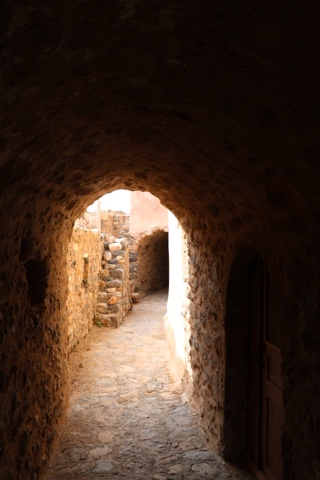
Passageway in the top town walls
Up on the top amongst the ruins
The residential area
Walkway along the walls
The far end of the town
Greek fishing boats in Gefyra
Beach off Monemvasia 
Gorgeous sunrise at Monemvasia